
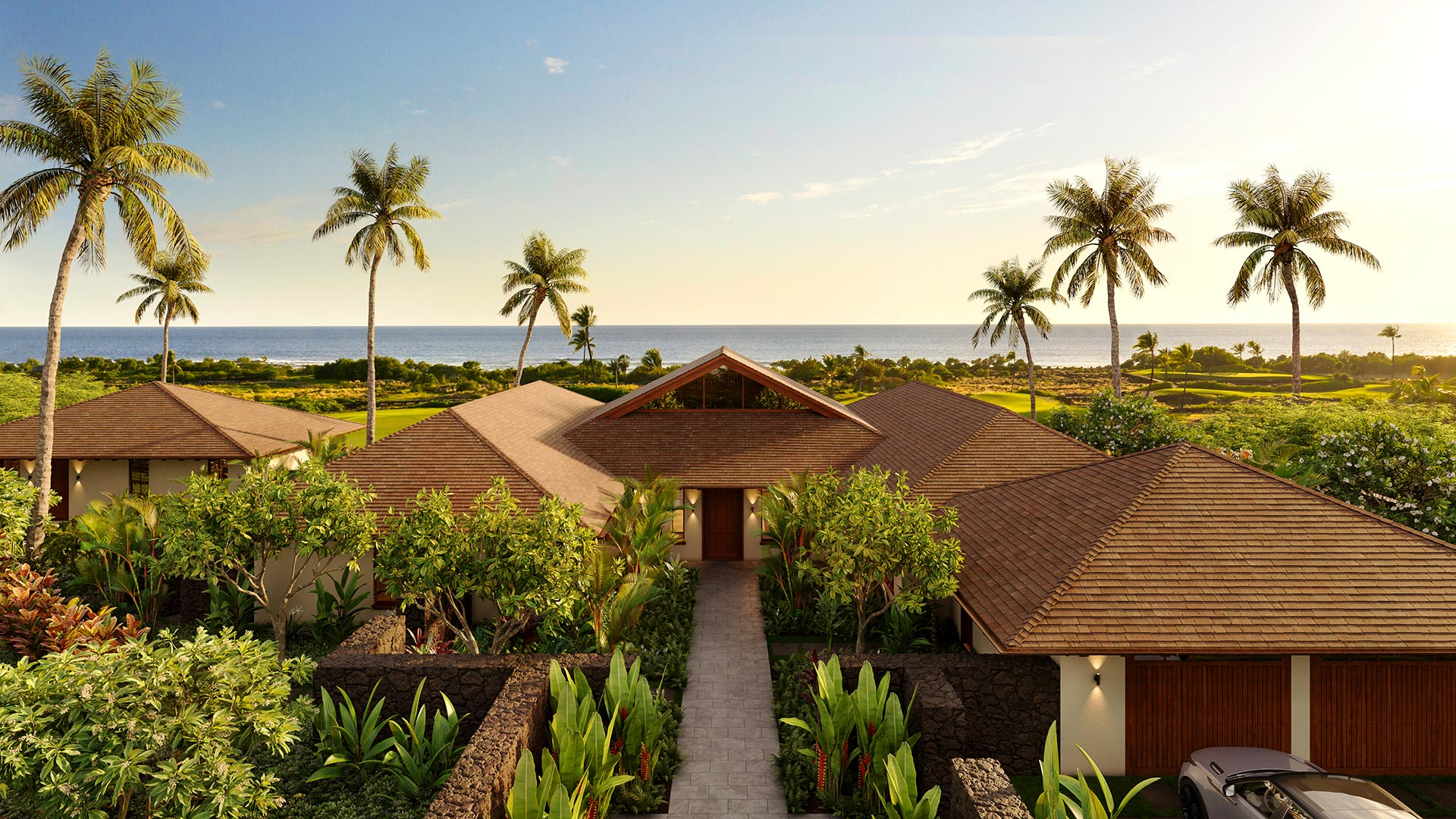
Architectural rendering in Hawaii is its own discipline. The same software renders a house in Phoenix and a house on the Kona coast, but the images succeed or fail on completely different details. Buyers, architects and design review boards in the islands have seen the real thing their entire lives, and they can tell instantly when a rendering was made by someone who has not.
Our studio has rendered Hawaii projects from Kauai to the Big Island, and keeps an office in Honolulu. This is what island work actually demands, and what to look for when you choose a studio for it.
Island Light Is the Whole Image
Hawaii's light is specific. Trade-wind clouds move fast and soften everything; late afternoon on a leeward coast goes gold in a way mainland light does not. Moreover, buyers respond to that light emotionally; it is half of what they are buying.
A rendering studio that defaults to generic mainland skies produces images that feel subtly wrong, even to viewers who cannot say why. In contrast, a studio fluent in island conditions builds the scene around them: correct sun angles for the latitude, humidity in the atmosphere, ocean color that matches the actual coast. For example, the water at Anini looks nothing like the water at Makena, and a knowledgeable buyer knows it.
Vegetation Cannot Be Faked
Nothing exposes an inexperienced studio faster than the landscaping. Island projects live among coconut palms, monkeypod, plumeria, naupaka and lava rock, species with distinct silhouettes that locals recognize at a glance. Generic tropical asset-library plants read immediately as false.
Additionally, landscape is often the argument in Hawaii entitlement work. A rendering that shows honest, correctly scaled vegetation at planting size versus maturity can decide how a project is received by a community. Therefore, ask any studio you are evaluating to show island vegetation from previous work, not a general portfolio.
Design Review Expects Honesty
Hawaii's design review culture of county boards, community associations and club design committees is rigorous, and it has a long memory for imagery that oversold. Photo montage work is especially scrutinized: the proposed building composited into a real site photograph, matched for camera, light and season.
As a result, credibility is a studio's most valuable asset in the islands. An honest montage that shows real massing from the actual public viewpoint will carry a hearing. A flattering angle that hides bulk will be noticed, and it will cost the project trust it cannot easily buy back.
What Island Projects Should Ask a Studio
Choosing an architectural rendering partner for a Hawaii project comes down to a short list of questions:
- Show me island work. Not tropical work. Hawaii work. The vegetation, light and water either ring true or they do not.
- Do you read our drawings? A studio with deep knowledge of the architectural design process works from schematic design and sketches, not just finished CAD.
- Can one model serve the whole campaign? Stills, film, 360 panoramas and VR should all be harvested from a single build.
- How do you handle review-board imagery? The answer should mention accurate viewpoints, honest massing and camera-matched montage.
The Pre-Sales Reality in the Islands
Hawaii's resort and club market sells almost entirely before completion. Buyers commit from the mainland, often from a sales gallery thousands of miles away, and the imagery carries the entire weight of the decision. Consequently, the visualization program is not a marketing accessory; for a year or more, it is the product.
The projects that sell well follow a pattern. They commission the 3D model early. They scope stills, film and panoramas as one program. Above all, they insist the imagery be believable to someone who knows the coast in question personally, because that is exactly who will be evaluating it.
Working Across the Pacific
Practical logistics matter less than they used to. Our studio runs from Honolulu and Bend, Oregon, and island work moves smoothly across that gap: drawings arrive digitally, reviews happen on video calls, and final assets deliver to the sales team wherever it sits. What cannot be remote is the knowledge: the light, the plants, the water, the review culture. That has to already be in the studio.
If you have an island project that needs to be seen before it is built, send the drawings. We know this coast, and we will give you a straight read on scope, timeline and cost.